
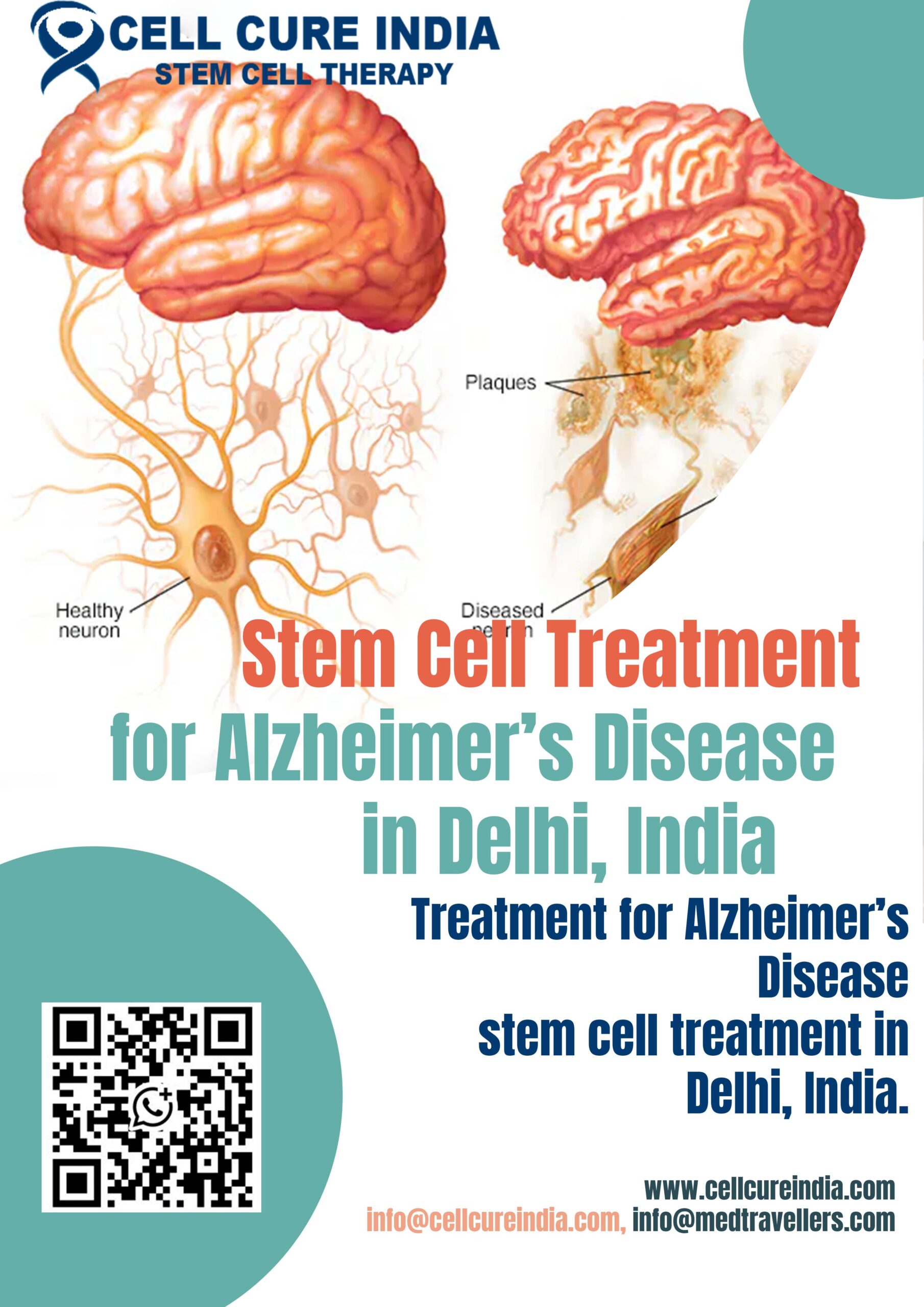
Stem Cell Treatment for Alzheimer’s Disease
Alzheimer’s disease (AD) is a progressive neurological disorder and the most prevalent type of dementia. It leads to memory loss, challenges with speech and comprehension, confusion, and ultimately, the inability to complete day-to-day tasks. AD typically affects individuals over the age of 65 and progresses over time but varies in its rate of progression. Individuals with AD exhibit unusual deposits of amyloid plaques and neurofibrillary tangles that disrupt the connections between nerve cells in the brain, causing atrophy of brain structures, and disrupt the usual communication between cells of the brain. Impairments in neurotransmitters—the chemicals that relay signals between cells in the brain—are also responsible for Alzheimer’s. Without proper levels of these chemicals, general brain function declines, leading to increased forgetfulness, mood swings, and confusion.
During the earliest stages of Alzheimer’s disease, when individuals may experience challenges with short-term memory, retrieval of facts from the past is possible. With progression of the disease, symptoms progress and include mood changes, decreased ability to focus attention, delayed motor coordination, decreased ability to communicate verbally, and decreased ability to perform basic self-care tasks, which can begin as management of eating and walking and eventually require assistance with dressing, bathing, or other day-to-day tasks. Risks cannot be reasonably assessed, but current treatment approaches focus on improving the availability of neurotransmitters to temporarily relieve symptoms of Alzheimer’s disease. A promising future treatment for AD may lie in the use of stem cell therapy to repair as well as repair the damage done by AD and restore cognitive function.
Symptoms of Alzheimer’s Disease
Some signs that someone with AD may exhibit are:
- Confusion about the time and day of the week.
- Difficulty learning and remembering new information.
- Difficulty finding the right words to express what they want to say.
- Becoming lost in familiar places.
- Experience increased difficulty completing everyday tasks such as cooking a meal or paying bills.
- Experience difficulty in making decisions.
If someone is experiencing these symptoms, they should see a physician as soon as possible.
Causes of Alzheimer’s Disease
It is widely agreed that Alzheimer’s disease is caused by a combination of genetic and environmental factors, which affect the brain over the long term, but in fewer than 1% of cases can be due to a specific genetic factor.
Types of Alzheimer’s Disease
Alzheimer’s disease can be broadly classified into two different forms: early-onset Alzheimer’s and late-onset Alzheimer’s. Regarding differences, early-onset Alzheimer’s and late-onset Alzheimer’s differ substantially in age of onset, potential genetic causes, and incidence.
Early-onset Alzheimer’s is a rare form, representing less than 5% of all cases of Alzheimer’s disease, and typically occurs in individuals under 65 years of age. It is seen more often in individuals with Down syndrome. Early-onset Alzheimer’s was seen to have a much deeper impact on brain changes compared to late-onset Alzheimer’s. Early-onset Alzheimer’s typically has a stronger genetic connection, representing defects in chromosome 14 that essentially mess with critical brain functions. Therefore, families of individuals with early-onset Alzheimer’s are likely to be at greater risk due to genetic abnormality.
Late-Onset Alzheimer’s is the most typical form of Alzheimer’s disease and often occurs in individuals 65 years of age or older. While scientists still do not know exactly what causes late-onset, they believe it is partially due to a combination of genetic and lifestyle factors, particularly errors in DNA over a lifetime. Having a family history of Alzheimer’s disease heightens the risk of developing Alzheimer’s; however, evidence suggests having a way of life that promotes mental activity (reading, puzzles, games, and simply learning) greatly reduces the probability of developing Alzheimer’s.
Diagnosis of Alzheimer’s Disease
The doctor will perform a physical examination to find any physical problems. The next examination will consist of a functional status evaluation, followed by a mental health assessment.
The blood tests to be done may include:
- Complete blood count (CBC)
- Thyroid function tests
- Vitamin B12 concentration
- Liver function tests
- Folate (folic acid) test
- HIV test, if the patient currently has risk factors for HIV or if the medical history warrants it
- Electrolytes and blood glucose (e.g., sodium, potassium, creatinine, glucose, and calcium).
The other tests that may be considered are:
- An electroencephalogram, or EEG.
- A lumbar puncture to test for certain proteins in the spinal fluid helps.
- Brain imaging studies (e.g., positron emission tomography (PET) and single photon emission tomography (SPECT)).
- Brain imaging tests (e.g., CT head scan or MRI of the head.)
Treatment of Alzheimer’s Disease
Recent studies have shown that MSCs may be able to repair and regenerate nerve cells and improve symptoms and life expectancy!! Again, steroids and other disease-modifying drugs are not able to address the entire spectrum of symptoms and are designed to manage only certain symptoms. The same concern with drugs is that side effects are a concern. There is no concern for side effects about MSC treatment.
FAQs
1. What is the definition of Alzheimer’s disease?
Alzheimer’s disease is a progressive brain disorder and the most prevalent form of dementia. It leads to memory loss, speech problems, confusion, mood fluctuation, and ultimately the inability to carry out day-to-day activities.
2. How can stem cell therapy be of benefit in Alzheimer’s?
The objective of stem cell therapy is to repair or regenerate damaged brain cells, restore any imbalances in neurotransmitters, and improve cognition, offering hope for something more than just symptom management drugs.
3. Is stem cell treatment for Alzheimer’s?
Yes, research clinics and hospitals in India, including clinics in New Delhi, have stem cell programs aimed at both slowing disease progression and improving patients’ quality of life.
4. Will stem cell therapy replace current standard treatments for Alzheimer’s?
No, current medications that may enhance neurotransmitters will likely still be used. In contrast, stem cell therapy seeks to ameliorate the damage caused by Alzheimer’s disease and offers the potential for the most comprehensive long-term benefits.